GUIDANCE
Being a BPCA member is all about taking pride in your work, and engaging with your local politician is a great way to show it. Here’s how.
Ciaran Breen, BPCA Policy and Campaigns Officer, explains how engaging with elected representatives can help raise your business's profile, open useful conversations, and ensure the voice of professional pest management is heard.
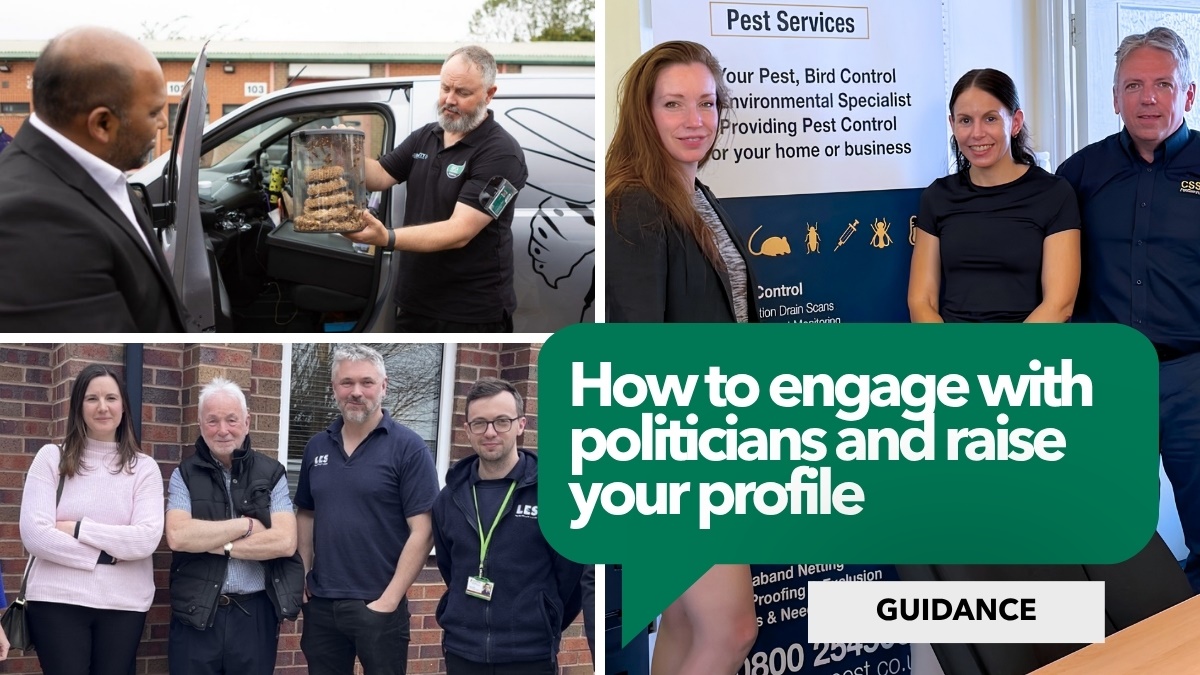
BPCA is committed to representing the industry, and elected politicians are one of the most important groups for us to engage with. They want to hear about your real-world experiences and how your work supports the communities they represent. Engaging with politicians can also create opportunities to raise the profile of your business.
Being a BPCA member shows that you take pride in being a pest professional and are committed to high standards.
Whilst pride may be one of the seven deadly sins, a little showing off can be a useful way to raise the profile of your business and the wider sector. Your MP, Member of the Scottish Parliament (MSP), Member of the Senedd (MS) or Member of the Legislative Assembly (MLA) can all be good people to engage with.
A meeting, tour of your office or even a site visit can generate press and social media attention, which may help introduce your business to new clients.
Engagement is also an opportunity to talk about the issues affecting your business and the wider sector.
One of the key jobs of an MP is constituency casework. They may be able to put you in touch with relevant people in government departments and agencies who can help resolve an issue.
Where the problem relates to law or regulation, you can make them aware of it and explain how people, businesses and communities are being affected. The right conversation has the potential to contribute to real change for the sector and its clients.
Here are some top tips for reaching out to your elected representatives and getting the most from the conversation.
1. Find out who they are
All you need is your postcode. You can search for their name and contact details on these sites:
Politicians will usually be most interested in businesses based in the areas they represent, so use the address where your business is based. If your business has several locations, you may be able to reach out to several politicians too.
2. Work out their interests
Many politicians have particular issues they’re especially interested in, and you’re more likely to get a response, and hopefully a meeting, if you can make your approach relevant to them.
This might relate to a former career, something they’ve spoken about publicly or a specific position they hold. Politicians may have roles in government, act as an official party spokesperson or sit on committees covering particular topics.
When you search for your politician’s details, many of their current and previous positions will be listed.
A quick Google search of their name or a look at their Wikipedia page can also help you understand the issues they’re interested in.
3. It all starts with an email
Politicians and their staff receive a lot of correspondence, so grab their attention quickly and keep your message relatively short.
Make sure to:
-
Appeal to their interests in the first few lines, for example, if they worked in healthcare, briefly mention how pest management supports public health. If they campaign for better housing, you could mention some of the housing conditions you’ve encountered
-
Introduce yourself and your business - you might include how long you’ve been trading, how many people you employ, notable sites you service in the constituency or awards you’ve received
-
Get to the detail - briefly expand on the issue, share your experience and give a practical example
-
Make an invitation, whether that’s for a meeting, an office tour, or a site visit.
Then send it and wait. Their offices can often take several weeks to reply, if they reply at all, so don’t worry if you don’t hear back straight away.
Any response and follow-up correspondence will almost certainly be with a member of their staff rather than the politician themselves.
4. You got a meeting
If you manage to secure a meeting with a politician, first of all, well done. But then what?
Remember, you may have been corresponding with their staff rather than the politician directly, so be ready to introduce yourself and your business again.
Ultimately, it’s just a conversation. There may not be a formal agenda. A politician will typically want to hear about you, your business and your professional experiences.
Tell your story, and have a few examples ready of how you and your business support the local community.
And remember to ask for a photo for social media or a press release.
5. Maximise the opportunity
BPCA can support you through every stage, including after the meeting.
We can advise you on particular politicians, help you work out what might interest them, suggest useful topics to raise and, in some cases, accompany you to a meeting.
BPCA’s Marketing and Communications team also works with specialist PR firm Shepherd PR. Together, we can help draft and share press releases with the media to get you and your business more attention.
Visits can also be covered through PPC and the BPCA website. Recent examples include LES Pest Management welcoming Maya Ellis MP, a member of the House of Commons Housing Committee, in March; Catherine Atkinson MP visiting CSS Pest Services in August; and Sojan Joseph MP joining Bounty Pest Control in September.
Make sure your Find a Pest Controller profile is up to date too, and consider signing up to TrustMark. If potential clients see you in the press, you want to make it easy for them to find and contact you.
If you’re interested in engaging with your elected politicians, contact policy@bpca.org.uk.